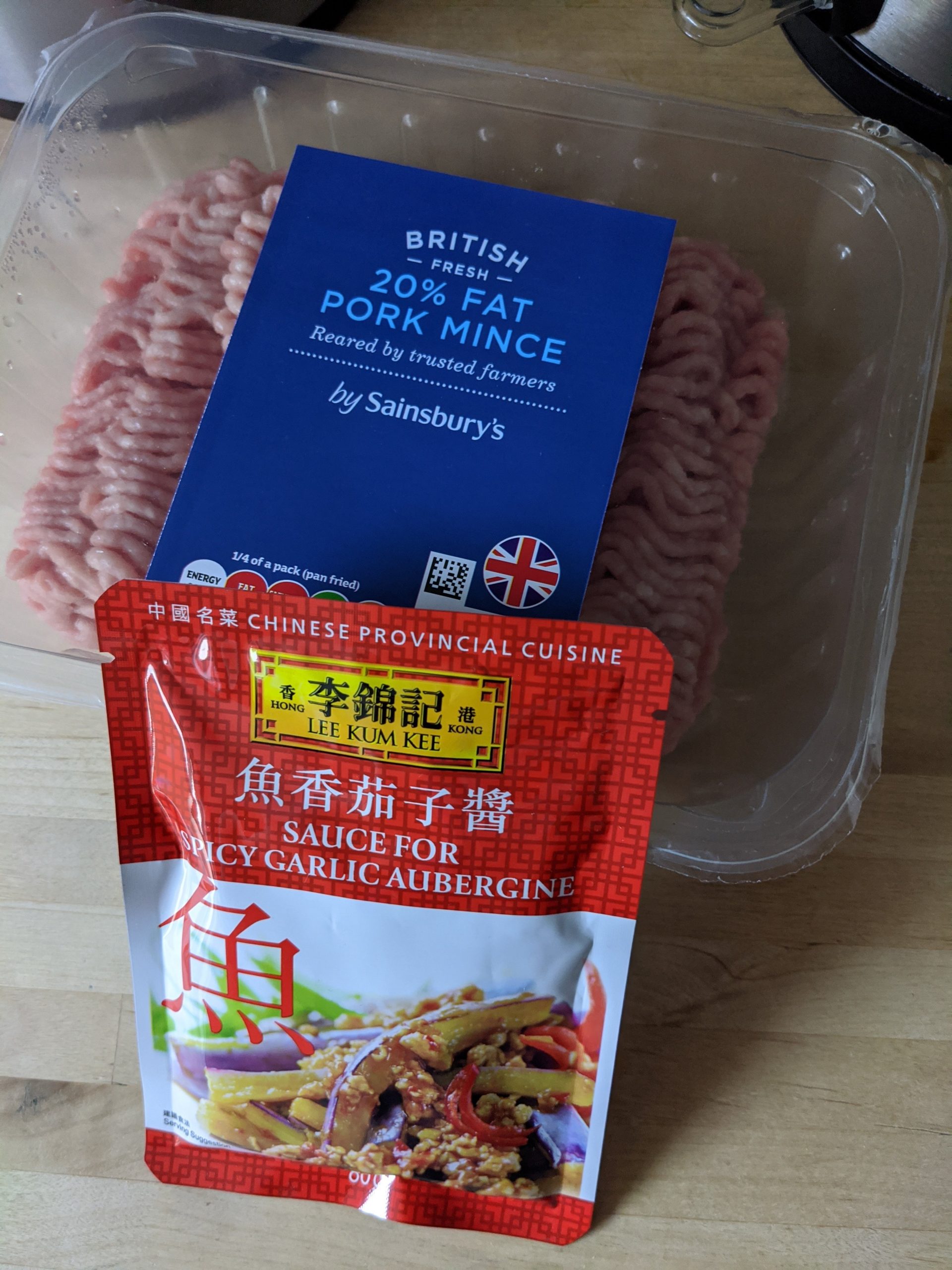
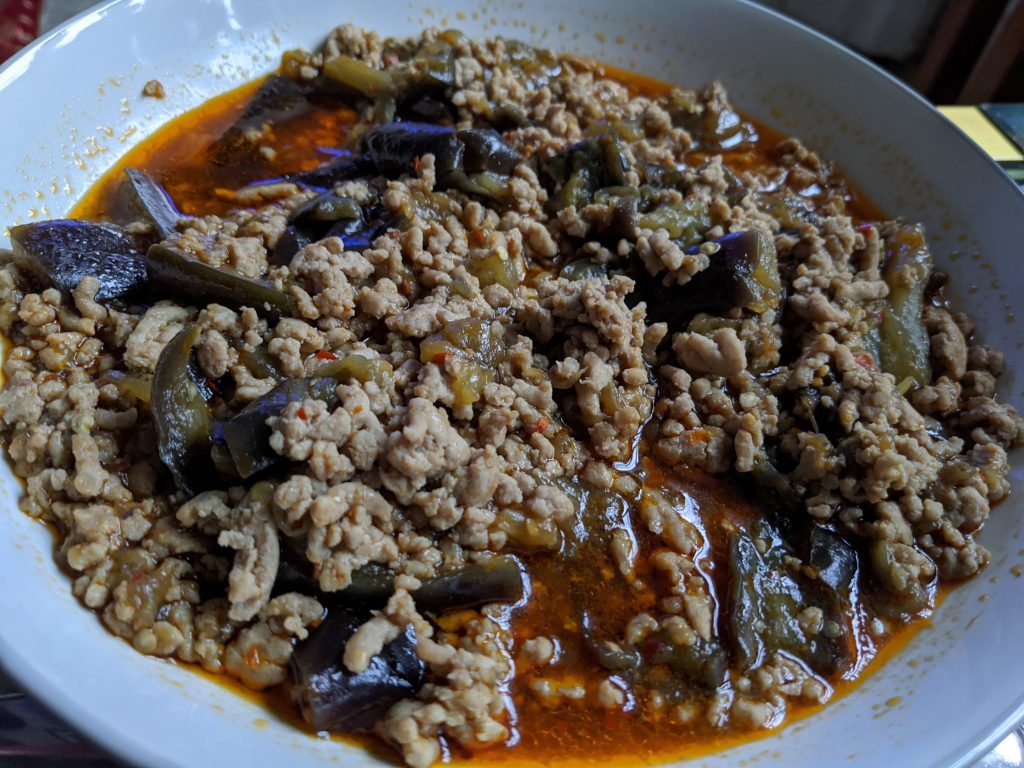
Usually, this dish is served in a sizzling hot pot at a restaurant, ideally after hours of slow cooking so the aubergine and mince pork practically melt into one within the fragrant salted fish sauce.
In order to replicate this at home, you would have to be able to find Chinese salted fish (鹹魚) and have a ceramic pot that you can get up to a searingly hot temperature. Not to mention time.
I came across this Lee Kum Kee sauce satchet for this dish and you know what, it wasn’t bad at all! All you needed was pork mince and aubergines (pre boiled) and simply add the sauce mix. I added about a tbsp of light soy sauce and a tbsp of fish sauce to the mix and it turned out quite well.
Nice, quick dinner dish, perfect with a bowl of rice.
Our local fishmonger (Bristol Fish Ltd) had some sashimi grade tuna in stock over the recent gloriously hot bank holiday weekend. So I decided on a whim to get some as I hadn’t had sushi for a while. Nothing beats freshly made sushi and they are so easy to make!
Daikon
Just look at this beauty!
Cook your sushi rice according to the packet. If you have a rice cooker then this step will be minimal effort. Prepare the ingredients you want to assemble within your maki roll sushi by cutting them into thin strips, the idea being that you will then line the ingredients up across horizontally on top of your nori seaweed and bed layer of rice, ready to roll.
The ingredients I used this time were my sashimi tuna, daikon radish, cucumber and crab sticks. You can pretty much add anything you want into your sushi rolls, even cooked meats like the korean gimbaps.
When your rice is cooked, add sushi vinegar to the rice and mix it up and allow your rice to cool a little bit. Tip:keep your rice spatula or spoon in a mug/bowl of water between scooping your rice, it will stop the rice from sticking to your spoon/spatula. Then you can start rolling. I would recommend using a sheet of cling film between your sushi mat and the nori sheets so that you do not have to keep washing your sushi mat between each roll. Place your nori sheet on top of your cling film, followed by a thin-ish layer of rice, then lay your ingredients across your rice horizontally. Around an inch from the bottom edge of your nori sheet. Now roll up your seaweed cylinder of deliciousness.
Once you have made all of your seaweed cylinders, then it is time to cut them up into the bite size maki rolls that one is more familiar with. Tip: wet your knife when cutting the rolls to stop the rice from sticking.
Now enjoy it with a bit of wasabi and sushi soy sauce. A cold beer also goes nicely…
Happy eating!
Scroll Up
Manage Cookie Consent
To provide the best experiences, we use technologies like cookies to store and/or access device information. Consenting to these technologies will allow us to process data such as browsing behaviour or unique IDs on this site. Not consenting or withdrawing consent, may adversely affect certain features and functions.
Functional
Always active
The technical storage or access is strictly necessary for the legitimate purpose of enabling the use of a specific service explicitly requested by the subscriber or user, or for the sole purpose of carrying out the transmission of a communication over an electronic communications network.
Preferences
The technical storage or access is necessary for the legitimate purpose of storing preferences that are not requested by the subscriber or user.
Statistics
The technical storage or access that is used exclusively for statistical purposes.The technical storage or access that is used exclusively for anonymous statistical purposes. Without a subpoena, voluntary compliance on the part of your Internet Service Provider, or additional records from a third party, information stored or retrieved for this purpose alone cannot usually be used to identify you.
Marketing
The technical storage or access is required to create user profiles to send advertising, or to track the user on a website or across several websites for similar marketing purposes.
Contains information related to marketing campaigns of the user. These are shared with Google AdWords / Google Ads when the Google Ads and Google Analytics accounts are linked together.
90 days
__utma
ID used to identify users and sessions
2 years after last activity
__utmt
Used to monitor number of Google Analytics server requests
10 minutes
__utmb
Used to distinguish new sessions and visits. This cookie is set when the GA.js javascript library is loaded and there is no existing __utmb cookie. The cookie is updated every time data is sent to the Google Analytics server.
30 minutes after last activity
__utmc
Used only with old Urchin versions of Google Analytics and not with GA.js. Was used to distinguish between new sessions and visits at the end of a session.
End of session (browser)
__utmz
Contains information about the traffic source or campaign that directed user to the website. The cookie is set when the GA.js javascript is loaded and updated when data is sent to the Google Anaytics server
6 months after last activity
__utmv
Contains custom information set by the web developer via the _setCustomVar method in Google Analytics. This cookie is updated every time new data is sent to the Google Analytics server.
2 years after last activity
__utmx
Used to determine whether a user is included in an A / B or Multivariate test.
18 months
_ga
ID used to identify users
2 years
_gali
Used by Google Analytics to determine which links on a page are being clicked
30 seconds
_ga_
ID used to identify users
2 years
_gid
ID used to identify users for 24 hours after last activity
24 hours
_gat
Used to monitor number of Google Analytics server requests when using Google Tag Manager